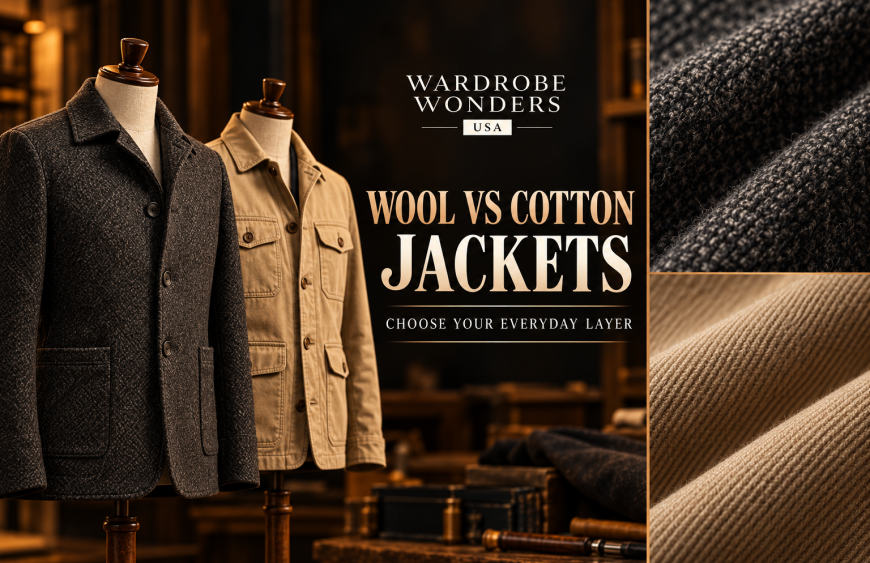
Choosing between wool vs cotton jackets starts with your daily routine. A short walk to a café, a cool morning commute, and an afternoon spent indoors can call for different kinds of layers. The most useful jacket is the one whose fabric, lining, and cut work together for the way you actually dress.
This guide compares the two options without treating a fabric label as a promise of warmth or weather protection. Use it to build a practical shortlist from Wardrobe Wonders’ wool and cotton collections.
Wool vs cotton jackets: the quick comparison
- For a textured, tailored look: start by comparing wool jackets with clean collars and simple fronts.
- For a relaxed everyday layer: explore cotton jackets in casual silhouettes.
- For warmth: compare the complete garment, including fabric weight, lining, length, and room for layers.
- For easy upkeep: read each jacket’s care label before deciding.
- For wet weather: look for an explicit weather-resistance specification; neither material name is enough.
These are shopping starting points, not rules. A thick, lined cotton jacket and a lightweight wool jacket may serve very different purposes from the versions you first pictured.
What wool brings to a jacket
Wool’s natural crimp can help trap air, contributing to insulation. The Woolmark guide to wool fiber explains the material’s properties. However, that background does not give an individual jacket a temperature rating. Its construction still matters.
For styling, a wool jacket can be a good place to look when you want visible texture and a more composed outfit. Compare the product photographs carefully: a smooth finish, a pronounced weave, and a patterned surface create different visual effects.
Browse the men’s wool jacket collection and note the shape you prefer. A simple front may suit a shirt and trousers, while a more casual design can work with denim. Choose the specific garment rather than assuming every wool jacket has the same formal character.
What cotton brings to a jacket
Cotton is used in many kinds of garments and can be engineered into different knitted and woven fabrics. CottonWorks’ material technology overview illustrates that versatility. A cotton label alone does not tell you how thick, flexible, or protective a jacket will be.
When browsing cotton jackets, focus on the details that suit your routine. Do you want a short casual layer, a longer silhouette, or pockets that make everyday errands easier? Compare the collar, hem, fastening, and visible fabric texture before choosing a color.
Explore the men’s cotton jacket collection or women’s cotton jacket collection to see which available shapes fit your wardrobe.
Match your jacket to an ordinary day
Write down the three situations in which you will wear the jacket most. Be specific: “walk to work with a backpack” is more useful than “winter,” and “weekend coffee over a T-shirt” is more useful than “casual.” Then evaluate your shortlist against those situations.
The commute
Think about sitting, carrying a bag, and taking the jacket off indoors. Check that the collar feels comfortable and the hem works with your usual trousers. If you carry a backpack, avoid choosing only from a front-view photograph; inspect the back and shoulder details too.
The weekend
Start with the clothes you already wear most often. A neutral jacket can make repeated outfit planning easier. If you want the jacket to be the focal point, keep the rest of the outfit simple and let its texture or color do the work.
The smarter outing
Compare cleaner silhouettes and quieter details. Try a wool jacket with a plain knit and tailored trousers, or a neat cotton jacket with a shirt and chinos. These are outfit ideas rather than dress-code guarantees; the occasion and the jacket’s actual design should guide you.
Check weight, lining, and layering room
The wool vs cotton jackets decision becomes easier when you compare equivalent details. Check fiber percentages, any stated fabric weight, lining information, garment length, and the size chart. If a description omits something important, ask the retailer before ordering.
Measure a jacket you already enjoy wearing and compare it with the seller’s measurement method. Decide which layer will sit underneath your new jacket. A fit you like over a shirt may feel different over your regular sweater.
During a try-on, fasten the jacket, reach forward, sit down, and check sleeve coverage. Look for comfortable movement as well as a shape you like. Avoid automatically sizing up without checking how the shoulders and sleeves change.
Make care part of the purchase decision
Read the care instructions for the complete garment. A cotton outer fabric does not automatically make a lined jacket machine washable, and a wool blend should not be treated using assumptions about another wool item.
If professional cleaning is required, decide whether it fits your routine and budget. Keep the care label accessible and ask for clarification when instructions are missing. Also review the store’s return and refund policy before ordering so you understand the conditions for assessing fit.
Build a shortlist you can compare
- Choose two jackets whose silhouettes you already like.
- Compare composition, lining, measurements, and care instructions.
- Picture each with three outfits you own.
- Check which one handles your most common daily situation.
- Resolve missing product details before you buy.
You may find that wool and cotton fill separate roles in your wardrobe. Start with the role you need most now, instead of trying to find one jacket that covers every occasion.
Frequently asked questions
Are wool jackets always warmer than cotton jackets?
No blanket comparison works for every garment. Evaluate the fabric weight, lining, coverage, and layers you plan to wear underneath.
Can I wear a cotton jacket in cooler weather?
Choose according to the jacket’s construction and your conditions. A lightweight casual jacket and a heavily lined model should not be treated as equivalent.
Which is easier to style?
The easier option is the one that works with your existing clothes. Compare actual silhouettes and colors rather than choosing by fiber alone.
Does either fabric make a jacket waterproof?
Do not assume so. Check for a clear product specification if rain protection is a requirement.