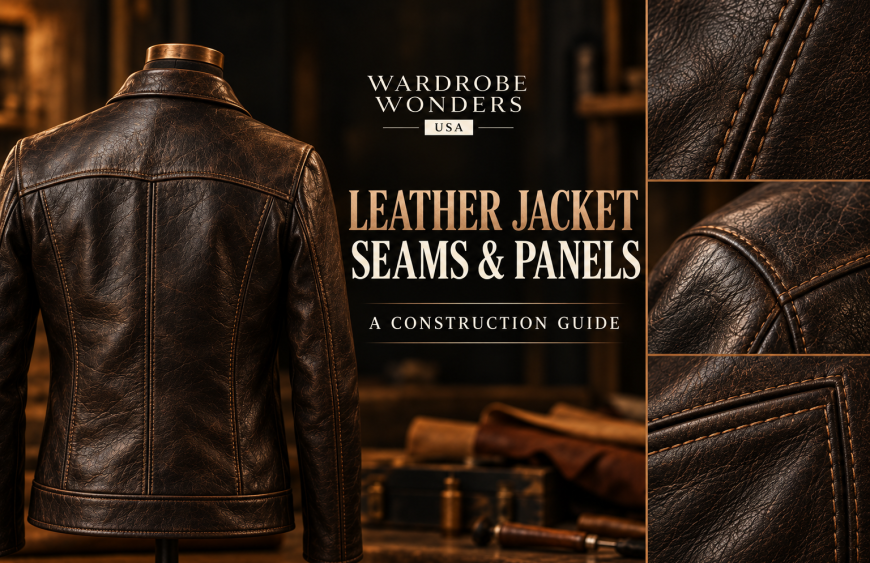
Leather jacket seams do more than draw lines across a garment. They join the panels that form the body and sleeves, while visible stitching adds detail to the finished design. Looking closely at these areas helps you understand a jacket beyond its color or silhouette.
This leather jacket seams and panels guide focuses on construction: what the main terms mean, which details you can inspect and what product photographs cannot tell you. It is a practical way to compare jackets without treating one design feature as a guarantee of quality.
Leather jacket seams, panels and stitching explained
A panel is a shaped piece of material used to build part of the jacket. A seam is the join between pieces. Stitching is the thread work used to hold parts together or finish a detail. Topstitching is visible on the outside, often running beside a seam or an edge.
These terms describe different things. A jacket can have a simple panel layout with visible stitching, or a more detailed layout with quieter stitch lines. For a technical overview of seam construction, see Coats’ guide to seam types. The exact method used on an individual jacket should come from its maker.
1. Read the panel layout from front to back
Start with the front, then look at the back and both sleeves. Notice where the material is divided and how those divisions form the shape. A center-back seam, side panels or a shoulder yoke may be part of the design.
A yoke is a separate section across the upper area of a garment. On a jacket, it can create a visible line across the back or shoulders. Do not assume that every line in a photograph is a join: some lines may be folds, decorative stitching or lighting.
Panel count alone is not a reliable quality ranking. Larger pieces and smaller shaped pieces serve different designs. Look at how neatly the panels meet and how the finished jacket sits on your body.
2. Look for consistent visible stitching
Follow a stitch line with your eyes rather than judging it from a distant product image. Check whether the spacing looks reasonably consistent and whether the line follows the edge or seam smoothly. Look closely at curves, corners and places where one line ends.
Contrast thread makes stitching more noticeable. Matching thread gives a quieter appearance. Neither choice proves better construction. Compare execution rather than thread color, and remember that a close-up photo still cannot show the strength of every hidden join.
Do not count stitch rows as a shortcut. One row and two rows can belong to different constructions. More visible thread does not automatically make a jacket more durable.
3. Inspect shoulder and sleeve joins
The shoulder area brings the body and sleeve together. When trying on a jacket, let your arms rest naturally first. Then bend your elbows and reach forward gently. Notice whether you feel pulling, an uncomfortable ridge or restricted movement.
Check the seam visually while the jacket is relaxed. If the area pulls only when you move, consider both the cut and the size. Our leather jacket fit guide explains the broader fit checks. A seam that looks tidy cannot compensate for a jacket that does not suit your movement.
4. Compare pocket edges and attachment points
Pocket openings create smaller construction details worth inspecting. Look at their corners, the surrounding stitch lines and whether the opening lies neatly when the pocket is empty. On patch pockets, examine the visible perimeter where the pocket is attached.
If you are shopping online, request a closer photograph when the details are unclear. Do not assume a dark shadow means damage, or that a smooth edited image confirms perfect finishing.
Construction and closures work together here. For zipper and snap checks, read our leather jacket hardware guide. That article covers operating the fasteners; this guide focuses on the material around them.
5. Check the hem, collar and cuff edges
Move around the jacket’s outer edges. Look for a finish that follows the intended shape without obvious twisting or an uneven fold. Compare the two cuff ends and both sides of the collar, allowing for deliberate asymmetry in the design.
A biker jacket may have an angled front and different-looking lapels. That is a design choice, so compare the jacket with its own product photos rather than demanding that every section mirror the other.
You can explore different silhouettes in our bomber vs biker comparison. Keep the style decision separate from your inspection of the finishing.
6. Look inside without disturbing the lining
Open the jacket and check the areas you can see easily. Look around the inside pockets, the lining edges and the sleeve openings. Gently move the jacket to see whether the lining sits comfortably rather than pulling in one area.
Do not pull the lining apart to inspect a hidden seam. Many joins are covered by the lining, and you should not damage a garment to examine them. Our leather jacket lining guide explains how the interior affects comfort and layering.
What to ask when buying online
Clear questions are more useful than broad claims such as “premium construction.” Before ordering, ask for the details that the listing does not show:
- Can I see a clear back view and a close-up of the shoulder seam?
- Is the visible stitching tonal or contrasting?
- Are the pocket openings and cuff edges shown close up?
- Does the lining cover the internal joins?
- What should I do if an attachment point arrives loose?
Use the individual description and photos when comparing our men’s leather jackets. A category image gives an overview; it does not establish the construction details of every product.
A simple leather jacket seams checklist
- Layout: Inspect front, back and sleeve panels.
- Stitching: Look for consistent lines, especially at curves and corners.
- Movement: Check shoulder comfort while reaching gently.
- Edges: Compare cuffs, collar and hem with the intended design.
- Interior: Examine visible lining joins without pulling anything apart.
- Questions: Ask for missing close-ups before you decide.
Frequently asked questions
Are fewer leather panels always better?
No. Panel layout is part of the design and shaping. The number of panels alone does not establish workmanship, comfort or durability.
Is contrast stitching a quality feature?
It is primarily a visible design choice. Judge how neatly the stitching is executed rather than assuming contrast thread is better than matching thread.
Can I judge all leather jacket seams from photos?
No. Photographs help you inspect visible details, but they do not reveal every hidden seam or how the jacket feels in motion. Ask for close-ups and check the seller’s terms.
What if I notice a loose seam on a new jacket?
Photograph the area and contact the seller before attempting a repair. Avoid pulling the thread or cutting it. Review the return and refund policy for the applicable process.
Leather jacket seams are easiest to assess when you look at the whole garment and then inspect the details. A thoughtful panel layout, neat visible finishing and comfortable movement are more useful checks than a single promise or stitch count.